
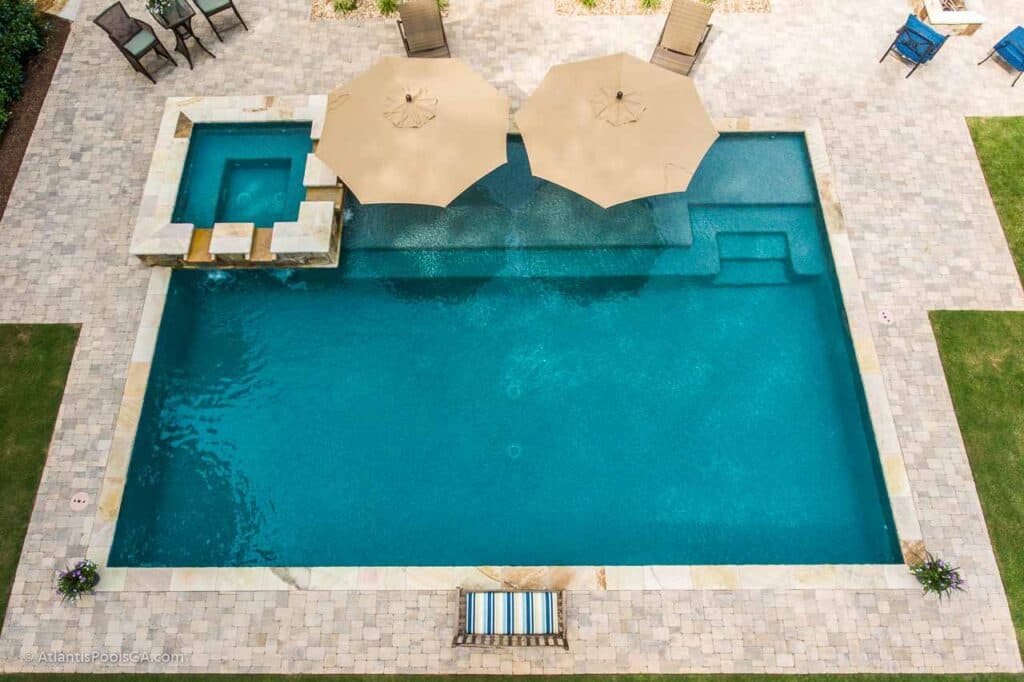
What actually moves the cost of a custom pool in North Atlanta.
There is no price list for a custom pool, because no two backyards start from the same site or end at the same design. Four things move the number every time: the site, the structure and finish, the outdoor living around it, and how connected the whole build is.
Kelly Jennings, Designer & Project Manager, Atlantis Pools & Spas. Genesis School Associate. Certified Pool Builder. Multiple PHTA Design Awards. 22+ years.
Why do two similar-looking pools cost so differently.
Two backyards that look alike from the street can land far apart in cost once the site, the structure, and the surrounding build are priced honestly. A flat, cleared lot with easy equipment access costs less to build on than a sloped lot with mature trees to protect. A pool built alone costs less than a pool designed alongside a spa, a pavilion, an outdoor kitchen, and stonework tying it all together.
This is also where a lot of estimates go wrong before a homeowner ever sees a real number. A builder can hand you a low figure for "the pool" and let the rest of the backyard show up later as change orders. We would rather walk you through what actually drives the cost up front, so nothing about your number is a surprise.
Four things drive the spread, and they are worth asking any builder to walk through before you sign anything:
1. The site. Grade, soil, access, drainage, and what has to be protected or worked around.
2. The structure and finish. Size, shape, engineering, and the finish on the shell.
3. The outdoor living around it. Spa, kitchen, fire, pavilion, decking, stonework.
4. How connected the whole environment is. One team designing pool and backyard together, or a pool with separate contractors added around it later.
Atlantis builds across a wide range, from a straightforward pool in the $140,000 range to a full-environment build approaching $1,000,000 and beyond, depending on scope. Where your project lands inside that range comes down to the four drivers above.
How much does my actual site change the price.
More than most homeowners expect. Slope, soil, access, and drainage are evaluated on every project, because the same pool design can cost meaningfully different amounts depending on what the ground is actually doing. See how Atlantis reads the site.
Georgia red clay. Red clay in the Atlanta area swells when it is wet and shrinks when it is dry, and a shell sitting in soil that keeps moving is a real long-term risk if the site work is not done right. Soil gets evaluated at the design site visit, before anything is priced, so the excavation and backfill plan is built around what the ground actually is, not a generic assumption.
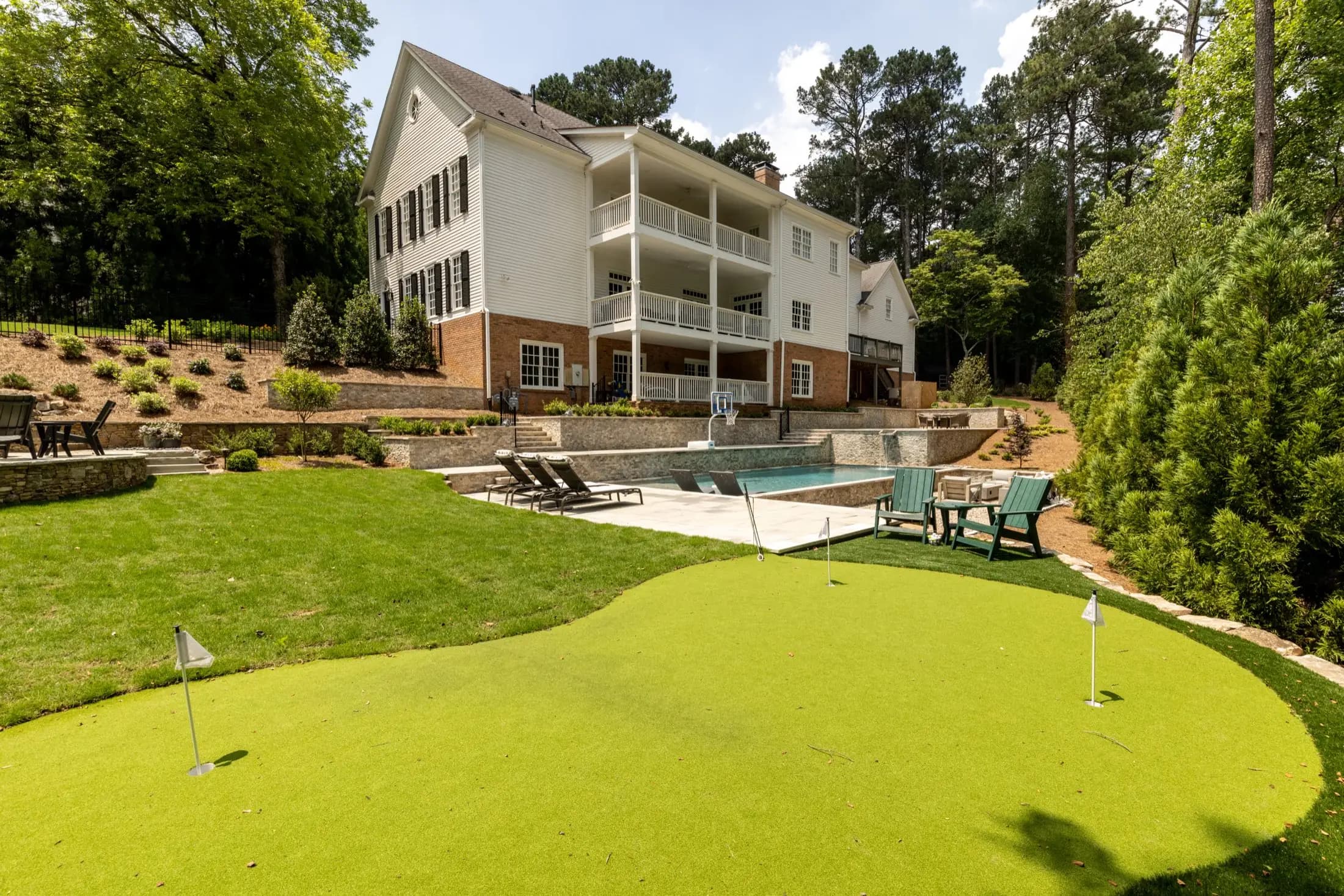
Slope. A sloped lot almost always costs more than a flat one. What it typically adds: more excavation and haul-off, retaining wall scope to hold the grade change, and a drainage plan that moves water away from the pool and the house instead of letting it pool against either one.
Access. A lot that equipment can reach easily costs less to build on than one that requires extra staging, hand-digging, or protecting a driveway and landscaping during construction.
Mature trees. Keeping mature trees usually takes real planning rather than ruling out the project. Trees affect where equipment can access the site, how close excavation can safely happen without damaging root systems, and sometimes the pool's shape or orientation. If keeping a specific tree matters to you, say so at the design site visit. It is far easier to design around a tree than to discover mid-build that root damage put it at risk.
The buyers who get burned on site conditions are usually the ones whose builder never raised them until they became a problem. Ask any builder how they evaluate soil, slope, and access before they price your project, and ask what happens to the number if the site turns out harder than expected.
How much do structure and finish choices change the cost.
A handful of structural and finish choices move a project up in cost regardless of the site. An integrated spa, an engineered edge, the finish on the shell, and added water features each carry their own design and construction scope. None of them are hidden costs. Each one is a choice you make with the design in front of you. See how pool engineering responds to the property.
- An integrated spa. A spa built into the pool design, sharing the same water feature, costs more than the pool alone but less than treating it as a fully separate structure.
- A vanishing edge or perimeter-overflow edge. These are engineered water features, not a finish choice, and they add real design and construction scope over a standard pool edge.
- Finish level. Plaster, pebble, and aggregate finishes carry different costs and different lifespans. Every Atlantis shell gets a lifetime pebble finish, and the finish you pick affects the number without affecting how it is built or backed.
- Water features. Slides, spillways, and raised elements each add engineering and construction time beyond a standard shell.
How much does building out the rest of the backyard add.
This is usually where the biggest swing in cost lives. A pool alone is one project; a pool with a pavilion, an outdoor kitchen, a fire feature, and the stonework tying them together is a much larger one. Atlantis builds spas, outdoor kitchens, fire pits, fireplaces and fire bowls, slides, pavilions, pool houses, and hardscape as part of the same design, not as separate contractor scopes bolted on afterward, so the number reflects a full environment instead of a pool with a lawn around it.
Renovations follow the same logic in reverse. Reworking an existing pool is real scope, and sometimes tearing out and rebuilding is the better call than trying to save a structure that will not support the design you actually want. Either path gets evaluated honestly at the design site visit, not assumed from a photo.
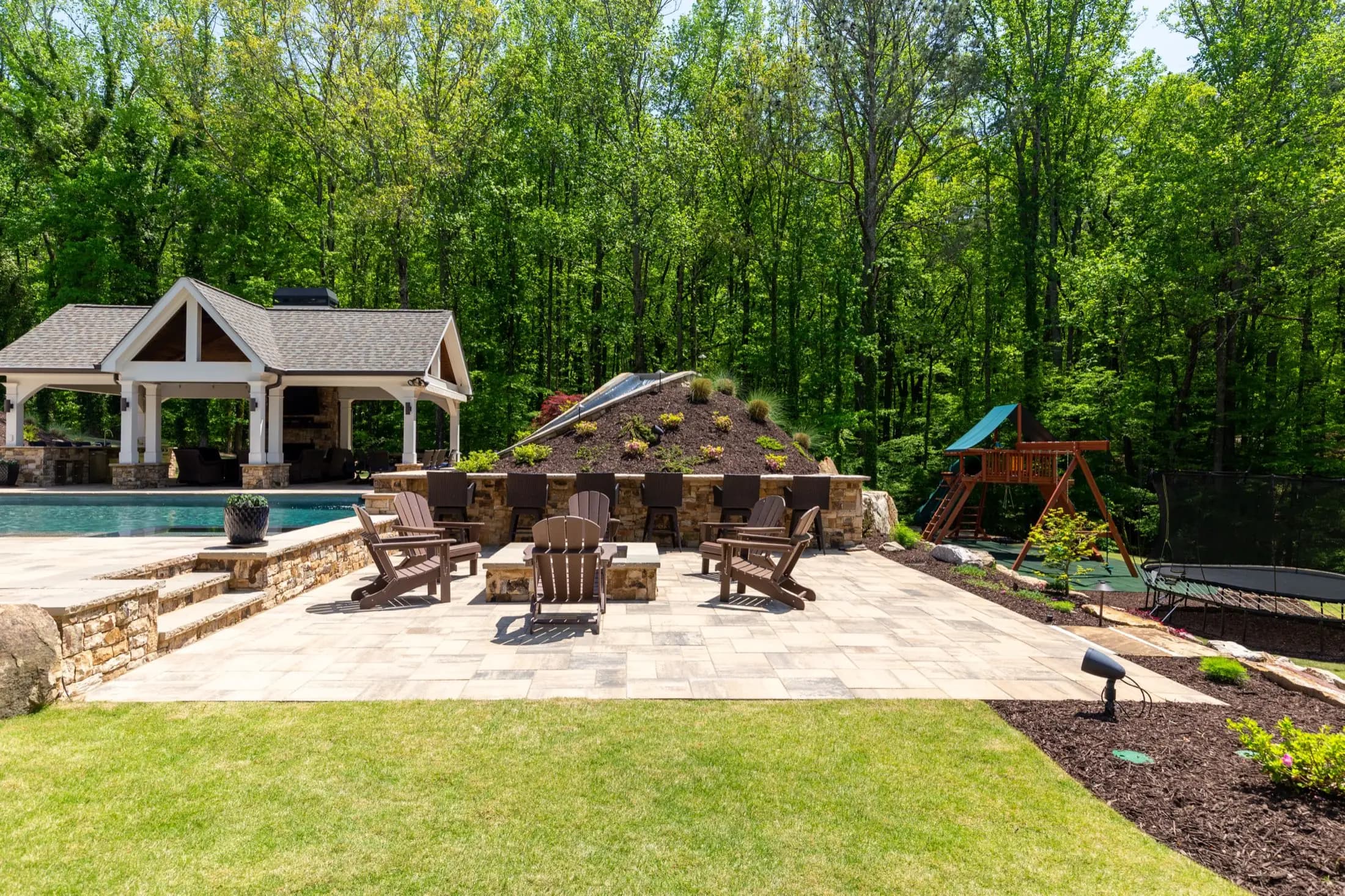
Batchelor · Roswell
Does it matter if one team builds the whole backyard.
Yes, both for the result and for the cost. A pool designed alongside the pavilion, the kitchen, and the stonework, by one team, tends to cost less overall than the same pieces bought separately from different contractors on different timelines, because the design accounts for all of it from the start instead of retrofitting each addition around what already exists.
The Batchelor project in Roswell is a real example of a full-environment build: a large lot with major elevation challenges, an oversized pool with an automatic cover, a pool house pavilion, a fireplace, an outdoor kitchen, and a fire pit, all designed and built together as one environment rather than added piece by piece. Most builders in North Atlanta will show you pool photos. Very few will show you the whole backyard, because very few design the whole backyard as one project.
Will permits or HOA review affect the cost and timeline.
Local permitting and any required HOA review affect your schedule, and application fees or required design changes can affect cost. The permitting authority depends on the property's jurisdiction. Homes within Milton or Alpharetta city limits follow their city's process; Fulton County's building-permit service applies to unincorporated areas.
HOA approval is separate from government permits. Ask for the current application checklists and confirm the review sequence for your address before setting a construction start date. Review times and supporting approvals vary by property. See the permit and HOA answers for links to the local authorities.
What is covered no matter how much I spend.
Every Atlantis pool carries the same protection regardless of budget or scope, including a larger backyard build. The shotcrete structure and the pebble finish each carry a lifetime guarantee. Hayward equipment is covered for three years, lights for four years, and workmanship for one year.
The first month of pool service, including chemical balancing, is included after your pool is filled, and Atlantis's sister service company stays involved through construction so the transition from build to ownership is handled by people who already know your pool. After that, Kelly and Bruce remain reachable directly.
Do I need financing to build a custom pool.
Most Atlantis clients do not use financing, and it is never something we raise unless you ask. For homeowners who want it, Atlantis works with an approved vendor, Lyon Financial, and can point you there during the contract phase.

Frequently asked questions.
Is there a price list for an Atlantis pool?
No. Every project is custom, so pricing depends on your site, your design choices, and how much of the backyard you build at once. Atlantis builds across a wide range, from around $140,000 for a straightforward pool to $1,000,000 and beyond for a full-environment build. A design site visit is what turns that range into a real number.
Why do two similar-looking pools cost so differently?
Two pools that look alike in a photo can differ enormously in site difficulty, shell engineering, finish quality, and how much outdoor living is built alongside them. A lower number sometimes means a smaller real scope, not a better price. Ask exactly what is included before comparing two quotes.
Does Georgia red clay really make pools more expensive to build?
It can, depending on the specific soil on your lot. Clay that swells and shrinks with moisture needs to be evaluated and planned for during excavation and backfill. Kelly evaluates soil at the design site visit so it is priced honestly up front rather than discovered mid-build.
How much does a sloped lot add to the cost?
It depends on the slope, the soil, and how the pool sits relative to the grade, so there is no single number that applies to every lot. A slope typically adds excavation, haul-off, and retaining wall or drainage scope. A site visit is the only accurate way to know what your specific lot adds.
Will permits or HOA review affect my cost and timeline?
Local permitting and any required HOA review affect your schedule, and application fees or required design changes can affect cost. The permitting authority depends on the property's jurisdiction. HOA approval is separate from government permits, so confirm the current requirements and review sequence for your address before setting a construction start date.
What is covered by warranty no matter what I spend?
The shotcrete structure and the pebble finish both carry lifetime guarantees. Equipment is covered three years, lights four years, and workmanship one year. The first month of pool service is included, and a sister service company stays involved through construction. None of this changes with project size.
Do I need to know my exact budget before I call?
No. Most homeowners start with a rough sense of range, not a fixed number. The first conversation covers your site and what you want the backyard to do, and the real number gets built from there, starting with a free design site visit.
How do I get a real number for my own backyard.
Every figure on this page is context, not a quote. The only way to price your project accurately is to walk the actual site. Atlantis starts with a phone conversation about your budget, your wants, and your lot's elevations, then a free design site visit where Kelly measures the site, reads the elevations, checks setbacks, and evaluates fit. From there, the custom design comes together over the next seven to ten days and gets presented at a follow-up design meeting, along with a detailed proposal. That proposal, not this page, is your real number. If you want to see where your project actually lands, the first conversation costs nothing and starts with a free site visit, not a phone estimate.