
Should you plan an automatic cover into your pool design.
If there is any chance you want an automatic cover, tell us before the design is final. The cover needs a pool shape it can travel over and a place for its track and mechanism. Some finished pools can take one later, but planning it in is simpler. Our Batchelor pool in Roswell has one.
Kelly Jennings, Designer & Project Manager, Atlantis Pools & Spas. Genesis School Associate. Certified Pool Builder. Multiple PHTA Design Awards. 22+ years.
Batchelor · Roswell
Why decide on a cover before the design is final.
An automatic cover needs the pool design to make room for it. It travels along the sides of the pool on a track, and the motor and the drum it winds onto sit at one end. Known about early, the coping, the deck and that end of the pool can be drawn for it from the first sketch.
When a cover comes up after the design is approved, it can often still be worked in, but something already drawn has to change. The coping gets detailed again, one end of the deck gives up room, or a curve gets a second look. Those are easy conversations on paper. They are harder once the shell is sprayed.
So if a cover is even a maybe, say it on the first phone call. That way it can be planned in from the start, and you can decide for sure once you see the custom design.
Which pool shapes can take an automatic cover.
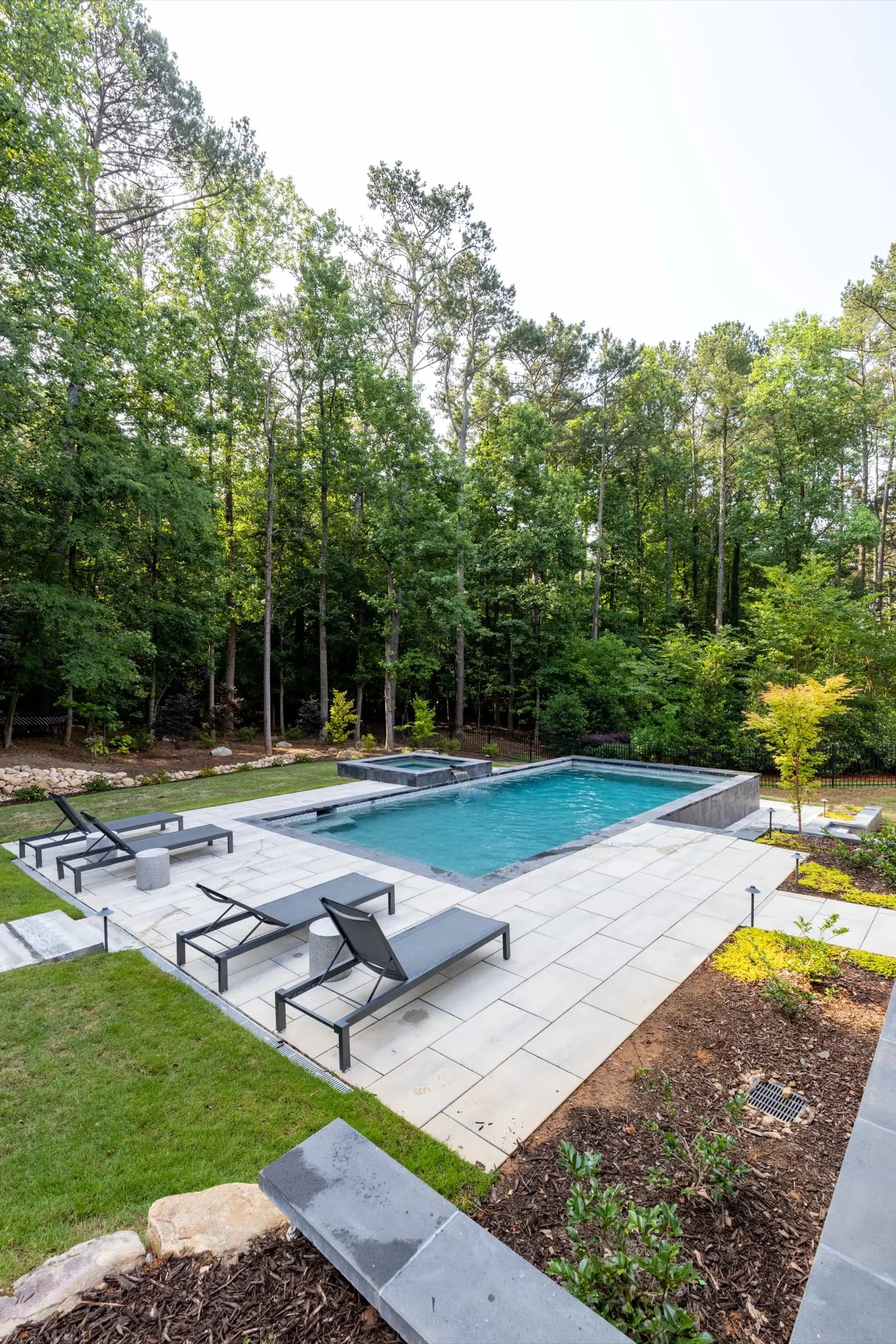
Rectangles and long linear pools are the simplest fit, because the cover runs in a straight line down two parallel sides. Curves, a freeform outline, a spa that spills into the pool or a beach entry can change what is possible. Whether your exact shape works depends on the cover system, so it should be checked against that system before the design is final.
Wanting a cover narrows the shape choices. How much it narrows them depends on the system. If a curved end or a freeform edge matters more to you than the cover, that is a fair trade, and it is better made on purpose than found out late.
Where do the track and the mechanism go.
The track runs along the two long sides of the pool and the mechanism sits at one end. Both can sit on top of the deck or be built in out of sight, and that choice changes how the edge of the pool and the deck around it are built. Which options you have depends on the system, so it gets settled during design.
The track.
A track mounted on the deck is simpler to add and easy to reach. A track tucked under the coping keeps the edge of the pool clean, but the coping has to be detailed for it before it is set.
The mechanism.
The motor and the drum need a home at one end of the pool, either in a housing on the deck or in a vault below it with a lid that sits flush. Either way it takes that end of the pool, so it affects where the steps, a spa or a seating ledge can go.
What does a cover look like on one of our finished pools.
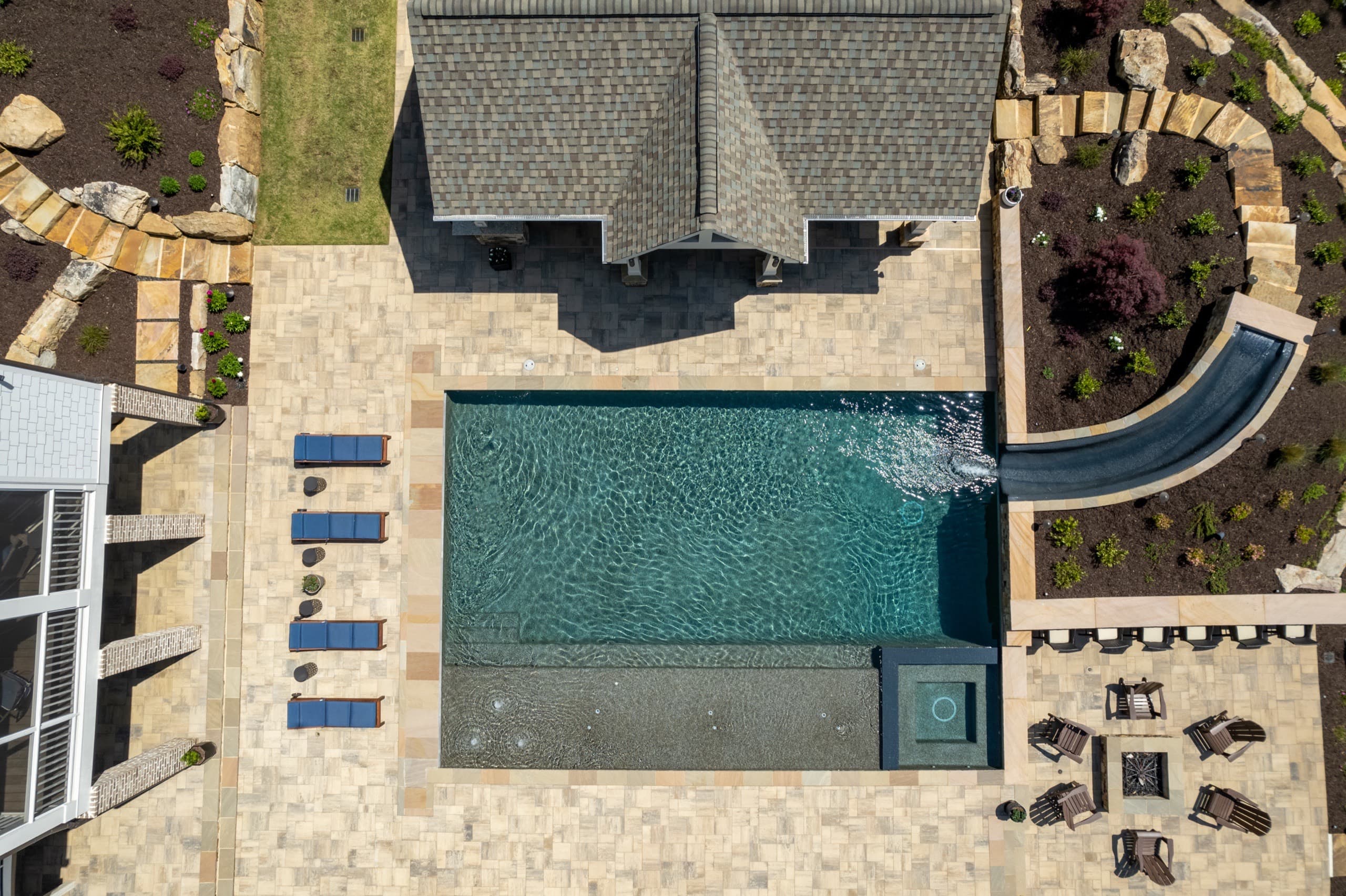
Our Batchelor project in Roswell is the published example. It is an oversized linear shotcrete pool on a big lot with major elevation challenges, with a tanning shelf, a raised spa that spills toward the water, a slide set into stone, travertine decking and an automatic cover.
The cover sits on the same long, straight pool that holds the rest of the backyard together, along with the pavilion, the fireplace, the outdoor kitchen and the fire pit. The full project, with photos of the slide, the spa and the pavilion, is on the Batchelor project page.
When is adding a cover to a pool you already have practical.
It is most practical when the pool has straight, parallel sides, room at one end for the mechanism, and coping or decking that can be cut or rebuilt for the track. It gets harder with curves, with steps or a spa where the mechanism would need to go, or with a deck you would rather not touch. Some pools cannot take one without real changes.
If you are already planning a renovation, that is the moment to ask. New coping or a rebuilt deck is the easiest time to add a track, because that work is happening anyway. Whether an existing pool can take a cover is a call to make on site, not from a photo. Our guide to renovating or rebuilding covers the rest of that decision.
Two questions so Kelly can start with your pool.
What does an automatic cover ask of you day to day.
A little attention every time it runs. Look over the pool before you close it, keep people and pets out of the water while it moves, and stay where you can see it until it stops. Keep the key or switch out of children's reach. Your system's manual has the full list, and we go through it with you.
Rain and leaves collect on top of a closed cover, and clearing them is part of the routine. Ask how your system handles standing water before you choose it.
At the exit meeting, Kelly or Bruce walks the finished pool with you and teaches every component. The cover is one of them. Ask every question you have while we are standing next to it.
Does an automatic cover replace a pool fence.
Sometimes. Some pool codes allow a powered safety cover that meets ASTM F1346 in place of a barrier, but local adoption varies. The office that issues your permit confirms what your pool needs, so check both the barrier and the cover with that office.
Until that office confirms it, plan the cover alongside the barrier, not in place of it. Who issues the permit where you live, and what that office asks for, is in our guide to pool permits in North Atlanta.
Frequently asked questions.
Should I decide on an automatic cover before the pool is designed?
Yes, if you think you might want one. The cover needs a shape it can travel over, a track along the sides and room at one end for the mechanism. Drawing those in from the first sketch is simpler than reworking coping and decking later. Mention it on the first call so it can be planned in from the start.
Can an automatic cover go on a freeform pool?
Sometimes. Straight, parallel sides are the simplest fit, and curves or a freeform outline narrow the options. Whether your shape works depends on the cover system, so check the shape against that system before the design is final.
Can you add an automatic cover to a pool that is already built?
On some pools, yes. It depends on the shape, whether there is room at one end for the mechanism, and whether the coping or deck can be reworked for the track. That is a call to make on site, not from a photo.
Does an automatic cover count as a pool barrier in Georgia?
Sometimes. Some pool codes allow a powered safety cover that meets the ASTM F1346 standard in place of a barrier, but local adoption varies. The office that issues your permit confirms what your pool needs, so check with them before the design is final.
How much does an automatic pool cover cost?
We do not publish a price for covers. What one adds depends on the pool, the system and how it is built in, so it is priced with your design rather than quoted on its own.
What do I need to do when I open or close the cover?
Look over the pool first, keep everyone out of the water while the cover moves, and watch it until it stops. Keep the key or switch out of children's reach. Your system's manual has the full routine, and we walk through it with you at the exit meeting.
Bring the cover up early, so it is part of the design from the start.
The site visit is free. Kelly measures the yard, reads the elevations and checks the setbacks. The custom design comes back in seven to ten days.